Hauts de France
Art, History & Archaeology Sites & Museums
The rich royal history of this the northernmost region of France can be seen in the many spectacular castles and palaces. In addition to which are some of the most magnificent Gothic cathedrals in France. Medieval heritage is only a part of the region’s history. Along the Somme River are some of the oldest archaeological sites in Europe. The same area known around the world for the Somme Battlefields of World War I. While along the coastline visitors can still see remnants of the Atlantic Wall of World War II. Whatever your interests, there is over 400,000 years of history to explore at many historical sites and in museums around the region.
Hauts-de-France is one of 13 regions of metropolitan France. The region was created in 2016 with the amalgamation of the Picardy and Nord-Pas-de-Calais regions. Five administrative departments make up this new region: Aisne, Nord, Oise, Pas-de-Calais and Somme. Belgium lies to the northeast, the North Sea in the very north, the English Channel to the west, as well as the French regions of Grand Est to the east-southeast, Île-de-France to the south, and Normandy to the west-southwest. It is connected to England via the Channel Tunnel. Some of the most well known and largest cities include: Amiens, Beauvais, Calais, Dunkirk and Lille.
This page, with details about the heritage sites and museums of the Hauts-de-France region of France, is part of our France Travel Guide. The information on this page is curated by various members of the Archaeology Travel team, based on both personal visits and research.
Create Itineraries & Travel Lists for Hauts-de-France
If you are planning a trip to the Hauts-de-France region of France, you can use our Itinerary Builder with the lists of sites and museums linked to below to create your own travel lists (such as places you have been to, places you would like to visit) and itineraries. These can be shared with your friends, privately and on social media. To make use of this feature, however, you will need to login or register as a new user. Registering to use these features is free of charge. Once registered and logged in, you can use the lists below to select sites and museums you would like to add to your itinerary and/or travel lists.
Cultural & Historical Highlights of Hauts-de-France
Looking for inspiration and ideas? The following are just a handful of the more popular cultural and historical attractions in Hauts-de-France. For more archaeological and historical sites and museums to visit, consult the departmental guides, linked to below.
Jardin Archéologique de Saint-Acheul
Saint Acheul is the type-site for the Early Palaeolithic Acheulean industry of stone tools. What visitors can see is an exposed section of prehistoric river gravels, with detailed information panels explaining the geological and archaeological significance. This is an important site for the history of archaeology. It was here in 1854 that archaeologists found stones, later to be called Acheulean hand-axes, that they argued had been modified by early humans.

Amiens Cathedral
Built between 1220 and 1270, the Cathédrale Notre-Dame d’Amiens is one of the finest examples of Gothic sacred art. A series of Renaissance polychrome sculptures inside the church depict Jesus cleansing the temple, while the western portal is decorated with early Gothic sculpture. Although free to visit, a tour of the towers and a visit to the treasury require separate tickets. The cathedral is well known for its spectacular light show, Chroma: which can be seen during the Christmas market season and from mid July to the end of September.

Beauvais Cathedral
From 1569 to 1573 this cathedral was the highest human construction in the world. The choir is still the highest Gothic choir in the world. Construction of the church began in 1225, but it remains incomplete: the choir and transept are complete, with the nave never built. The 10th century Romanesque cathedral still stands where the nave should have been. Inside the church are 15th and 17th century tapestries, but it is for the 13th, 14th and 16th century stained glass windows that the cathedral is particularly admired.

Château de Pierrefonds
The castle of Pierrefonds was built in rapid time, ten years, and completed in 1397 for Louis d’Orléans, son of King Charles V. During the reign of Louis XIII the castle was besieged and reduced to a ruin, later being referred to as the ‘romantic ruin’. Under Napoleon’s III orders, the French architect Viollet-le-Duc started to restore the ruins in the second half or the 19th century. But much of what we see at Pierrefonds today, both inside and out, is Viollet-le-Duc’s reinterpretation of Renaissance and Middle Ages architecture of France. Nonetheless, there is still much to see of the original castle fort, whether by self-guided tour or a guided tour.

Château de Chantilly
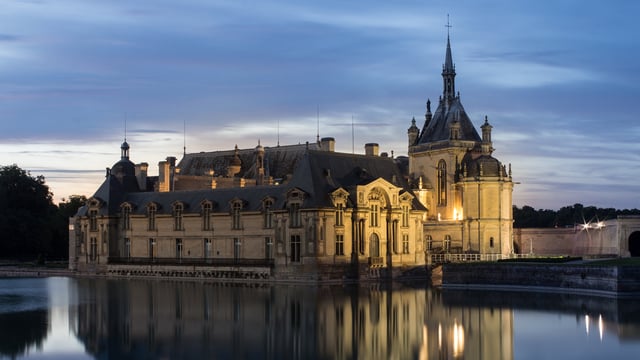
What is today one of France’s finest Renaissance castles was built on the site of an 11th century fortress that had command of the road between Senlis and Paris. Through eight centuries of tumultuous history, Chantilly Castle passed between a number owners, and modifications, before it became an exceptional art museum, the Musée Condé. Besides the art galleries, visitors can explore the private suites, lavishly decorated in 18th century décor. In the grounds visitors can stroll through the French formal garden and visit the stables – the largest princely stable in Europe, now home to the Museum of the Horse.

Armistice Memorial
On the edge of the Forest of Compiègne is the location where the Armistice that brought an end to the Great War was signed in 1918, and another signed on 22 June 1940 between the Germans and French following the German occupation of France. The memorial site comprises the Armistice Glade and the Memorial Museum. A series of displays traces the development of the site from the end of WW1 to early WW2. The original carriage was destroyed in 1945 in Berlin, now visitors get to see a near identical carriage, that has been staged for the signing of the first Armistice.

Thiepval Memorial to the Missing of the Somme
Designed by Sir Edwin Lutyens, the Thiepval Memorial to the Missing of the Somme has been described as “the greatest executed British work of monumental architecture of the twentieth century”. Construction began in 1928. Four years and 10 million bricks later it was completed at the cost of £117,000, which is the equivalent today of around £10 million. The result is not just a memorial to all those that fought and died on the Somme, but one that acknowledges the British and French alliance during the battle, and perhaps most importantly, it commemorates over 72,000 British and South African soldiers that have no known grave.


Canadian National Vimy Memorial
The Canadian National Vimy Memorial is situated on the highest point of Vimy Ridge – the site of the Battle of Vimy Ridge, which took place from 9 to 12 April in 1917. The memorial is dedicated to the memory of the battle and the Canadian Expeditionary Force members killed during the First World War, as well as those Canadians killed in France during WWI with no known grave. Besides the striking memorial, nearly 40 m high, the memorial site has also preserved parts of the battlefields, including trenches and craters. Visitors can take guided tours of the preserved underground tunnels. A visitor centre outlines the relevance of the site, its history and its significance for Canadians today.

Éperlecques Bunker
The Blockhaus d’Éperlecques was built by Nazi Germany between March 1943 and July 1944 intended to launch V-2 ballistic missiles from France to London. The bunker was built using prisoners of war and other forced labour. It was designed to launch 36 missiles per day. Aerial attacks from the Allies meant the construction was disrupted and it was never completed to be used for launching missiles. Éperlecques was captured from the Germans in September 1944, but it was not until much later was the true purpose of the bunker revealed. An interesting audio tour guides visitors on a present path through the facility.

Louvre-Lens Museum
Constructed on a reclaimed coal mine, the designers wanted visitors not to be able to see where the landscape ends and the building begins. And they succeeded. The park is as much an attraction as the state-of-the-art museum – itself an extension of the Louvre Museum in Paris. The main, permanent exhibition is the ‘Galerie du temps’, in which 200 artefacts from the 4th millennium BC to the mid 19th century are displayed in chronological order. These objects represent various techniques and civilisations. The museum also hosts important temporary exhibitions.

Guides to the Departments in Hauts-de-France
Aisne
Known as the ‘crowned mountain’, the medieval city of Laon rises over one hundred metres above the surrounding flat countryside. First fortified by the Romans, today visitors are in awe of the Gothic cathedral surrounded by stone houses that occupy the hilltop. But this is an area with numerous castles, abbeys and cathedrals to visit. The 18th century Chemin des Dames tells the story of the areas Great War history.
Nord
Nord is historically a Flemish region, hence it being called French Flanders. Since Roman times the area making up the Nord department has been a shifting linguistic border between Germanic and Romance languages. Today from Dunkirk to Lille, the Nord has some of France’s finest regional museums, as well as 11 UNESCO listed Belfies – from the Romanesque to the Baroque.
Oise
Pas-de-Calais
Better known for the battlefields and memorials of the First World War, in Pas-de-Calais there are also important Second World War to visit. With charming, historic seaside towns along the Opal Coast and medieval castles and fortified towns. With one of the finest museums in Europe and UNESCO listed coal mines in Lens; there is more for culture and history enthusiasts to explore than World War heritage.
Somme
It was in the gravels of the Somme River that early archaeologists first identified stone hand axes as human in origin. Poignant memorials and cemeteries for men of all nationalities lie beside the battlefields where these men fell during the Great War. From the early Sone Age to the devastating events of the 20th century, heritage sites in the Somme area span many thousands of years.