Travel Guides by Experienced Archaeologists & Historians

Aosta Valley
Art, History & Archaeology Sites & Museums

Aosta Valley is a small Alpine region in the north-west of Italy. Popular with hikers in the summer and skiers in the winter, and cultural travellers all year round. The region shares its international border with France and Switzerland. The highest mountain here, in the very north-west corner, is Monte Bianco (or Mont Blanc). Valle d’Aosta is the smallest and least populous region in Italy. Valle d’Aosta means ‘Valley of Augustus’, after the Roman Emperor Augustus who seized the area for its strategic mountain passes from the local Celtic Salassi tribe in about 25 BC and established Augusta Prætoria Salassorum (modern-day Aosta). As Italy’s smallest region, it is not further subdivided into provinces. The official names, in Italian is Valle d’Aosta and Vallée d’Aoste in French.

Create Your Aosta Valley Itinerary & Travel Lists

Archaeology & History Sites in Aosta Valley

Aosta

The city of Aosta lies on a plain in the centre of the Aosta Valley, connected to France and Switzerland by two passes through the Alps. Also known as the Rome of the Alps, it was founded by the Romans during the war with the Salassi people. It became a transit point for the Via Francigena during the Middle Ages. Its long cold winters, short warm summers, and proximity to famous ski areas make it a perfect destination for mountain and snow lovers.

Megalithic Area of Saint-Martin-de-Corléans

The archaeological site, only recently reopened on 11 November 2023, also includes a museum. Six metres below the current street level is the prehistoric site, one of the most interesting in Europe. Human activity here started in the middle of the 5th millennium BC when two large necropolises were built. Visitors to the site can see the dolmen that dominates the centre of the archaeological area, 46 marvellous anthropomorphic stelae, once stacked in the ground, and and a number of megalithic tombs. These features show the sites function as an important sanctuary.

Pont D’Aël

Today the Roman bridge is part of a popular hiking trail in a side valley of the Aosta Valley. In 3 BC this bridge was part of a six kilometre aqueduct that carried water to present-day Aosta for agricultural purposes in the then colony of Augusta Prætoria Salassorum. The top of the bridge is 66 metres above the valley floor, and when built there would have been a roofed control corridor. A Latin inscription on the bridge records that it was constructed by Caius Avillius Caimus from Padova using private funds.

Pont Saint-Martin

When the Romans defeated the Salassi tribe, it was the strategic mountain passes that they sought to control. In securing the mountainous routes they built a number of roads and bridges. The remains of some of these ancient roads are still visible in many places along the valley, and even the modern railway line follows these ancient routes. The single segmental arch bridge over the Lys River in Saint-Martin is one such Roman bridge. The bridge has a span of 35 metres, and a width of 4.5 metres.

Roman Aosta - Augusta Prætoria Salassorum

Once the centre of the Salassi Celtic tribe, Augusta Prætoria Salassorum was prized for its strategic position and became an important military post. In fact Aosta’s layout still resembles that of a Roman military camp. Many architectural features from the town’s Roman times have survived and some are quite well preserved. The city walls, for example, are all but complete, and six of the original 20 towers are still standing. The remains of the theatre, amphitheatre and forum can be visited, while a triumphal arch to Augustus still has pride of place.


Roman Consular Road - Donnas

Just west of the town of Donnas, on the north side of the SS26 is a 221 m section of the Roman consular road, with its arch and milestone. Known as the Via delle Gallie, Gauls Road, it was built to link Rome to the  Aosta Valley. The milestone has the number 36, being the number of miles between Donnas and Aosta. The road and arch was cut into the bedrock. And on the road’s surface you can still see cart wheel ruts. A nearby carpark gives access to a footpath running between the Roman road and the motorway.

Forts & Castles in the Aosta Valley

Cly Castle

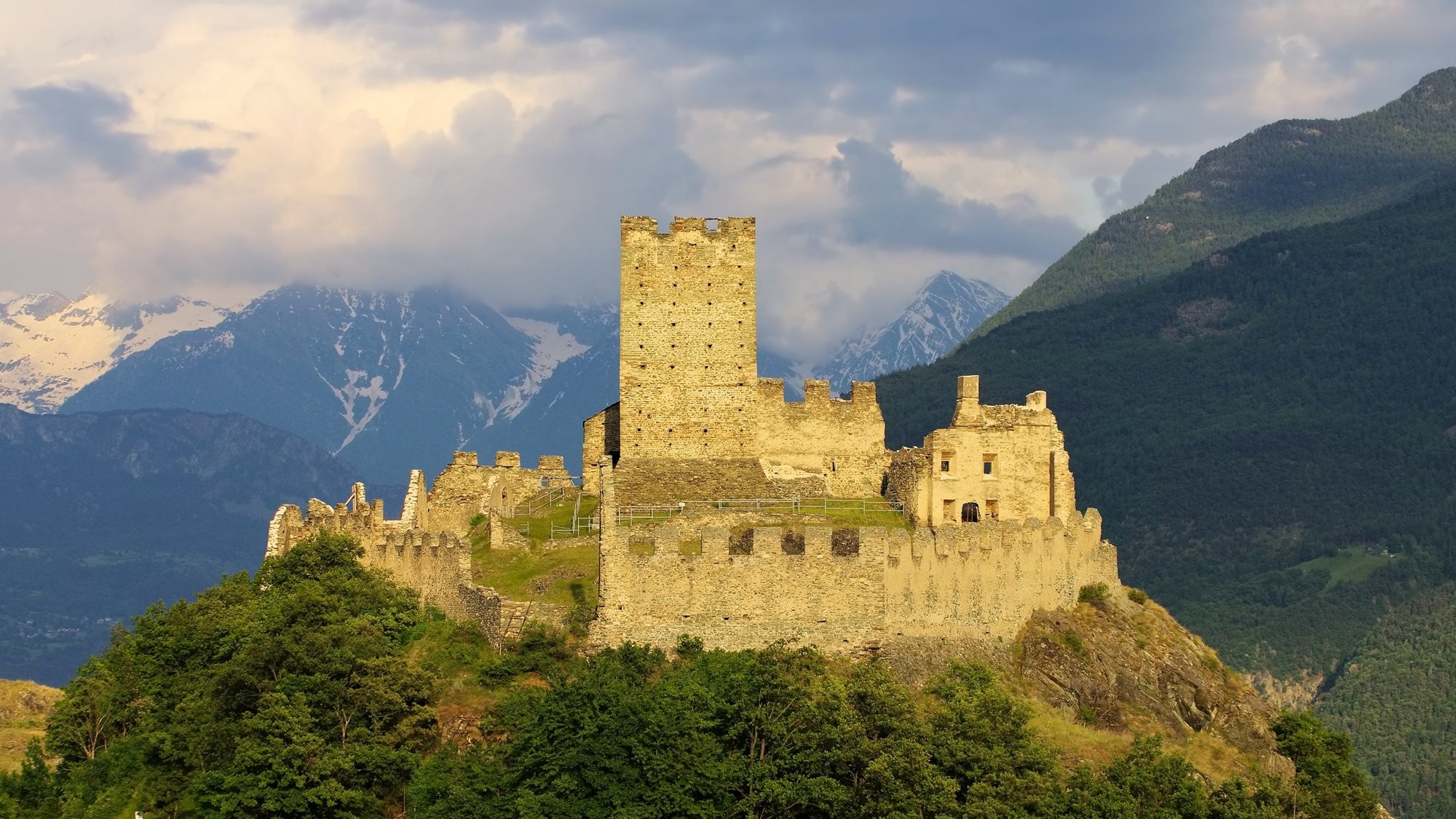
Cly Castle is a typical example of a Valdostan medieval fortress. Namely a central square tower surrounded by a defensive wall, and placed in a strategic location to exploit the natural defensive elements of the setting. Tree-ring analyses indicate that the castle was built in 1027 AD, making this one of the oldest castles of its type in the Aosta Valley. Of particular note is the Romanesque chapel within the fortification. Inside the chapel are frescoes from three distinct periods in the 13th and 14th centuries. Sadly, these are not well preserved, due to preservation and vandalism.

Fénis Castle

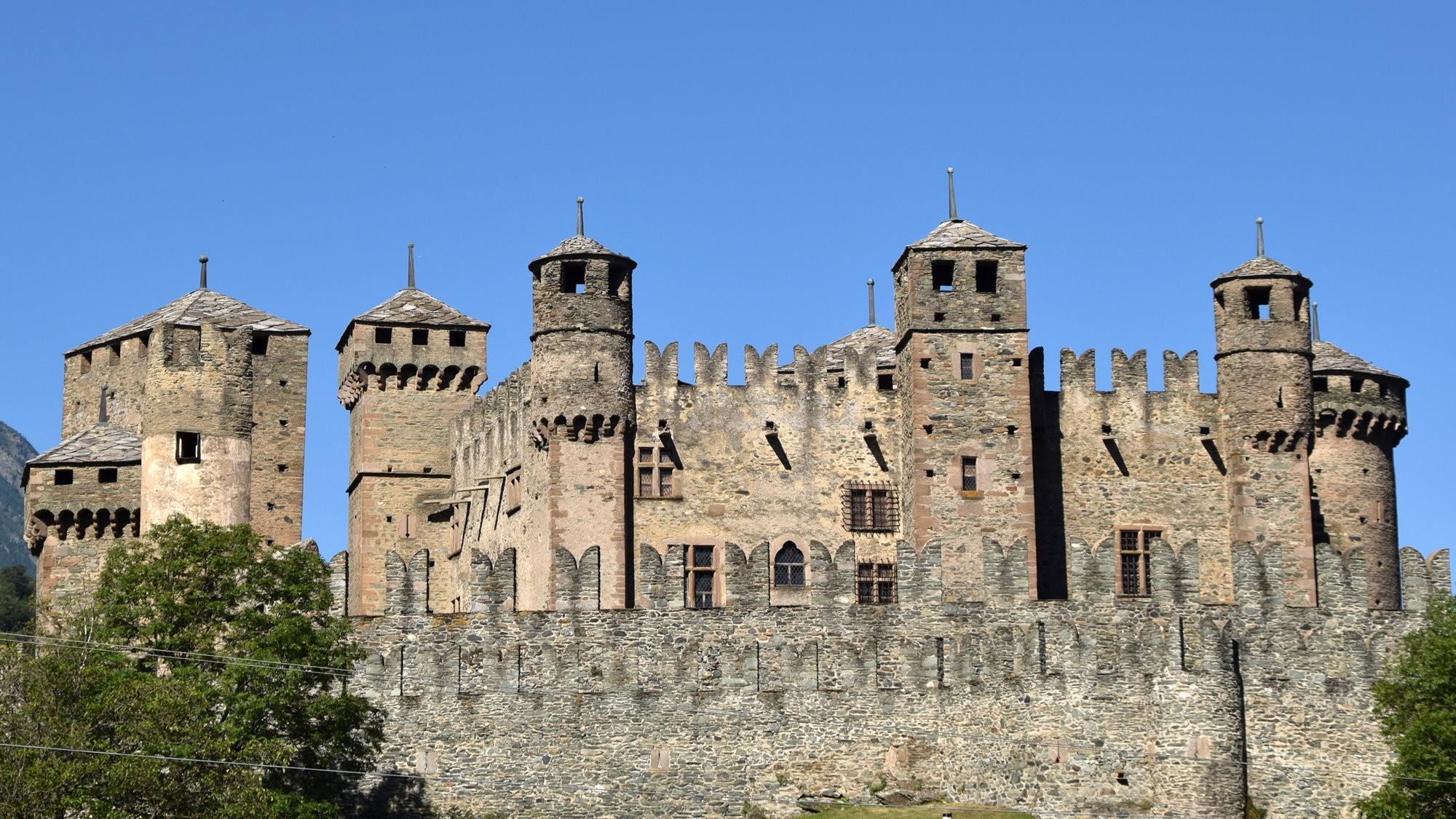
This Medieval castle is one of the most visited tourist attractions in the Aosta Valley. The castle has a typical defensive layout, which includes a pentagonal keep with towers at each corner. The keep is surrounded by a double wall complete with battlements, watchtowers and walkways. Built on top of a small hill and contrary to first impressions, the castle did not have a military or defensive purpose. Rather, it was a prestigious family residence. What visitors see today dates to the early 15th century.

Museums & Art Galleries in Aosta Valley

MAR - Regional Archaeological Museum

The museum, renovated in 2010, displays evidence of human activity in the Aosta Valley from prehistory to the Middle Ages. The first room is dedicated to the prehistoric finds, particularly those from the nearby megalithic site of Saint-Martin-de-Corléans. The Roman section, however, is the real highlight of the museum. Many artefacts from the ancient city of Augusta Praetoria are on display, grouped according to thematic areas that show different aspects of daily life. Numerous artefacts represent the Christian/medieval era, including an 8th century pulpit found during excavations of the Cathedral of Aosta.