
The small island of Delos has one of the most important archaeology sites in Greece. The only way to visit the site is to get a day return ferry from a nearby island (Mykonos, Paros or Naxos). There is no accommodation on the island. As an archaeologist who has visited the island a number of times, I set out all the information and tips you need to make your visit to this extraordinary archaeological site a memorable one, whether you are passionate about Greek history or just an incidental visitor. I strongly recommend you buy a ferry ticket in advance, particularly for the busier months.
Please Note: Delos is closed until the end of March 2024.
- Thomas Dowson
- Last Checked and/or Updated 11 March 2024
- No Comments
- Greece, Greece Travel Tips, Travel Tips
Delos Transfers & Guided Tours
Ferry Transfer to Delos
- Roundtrip ferry to Delos
- Doesn’t include site entry €12
- No guide to the site
- Refundable
More information, and/or book online, or select your visit date and other options on the calendar below.
Ferry Transfer & Audio Guide
- Roundtrip ferry to Delos
- Doesn’t include site entry €12
- Smartphone audio guide
- Refundable
More information, and/or book online, or select your visit date and other options on the calendar below.
Transfer & Guided Tour of Delos
- Roundtrip ferry to Delos
- Skip-the-line entry
- Guide tour of the site
- Refundable
More information, and/or book online, or select your visit date and other options on the calendar below.
Archaeology Travel may earn a commission at no extra cost to you should you decide to purchase them.
I first visited Delos towards the end of summer in 1990. This was during my island hopping adventure that took me from Crete to Athens. The ferry ride to the island was as unforgettable as the archaeological site. The crossing was not smooth and I have been saved by advice I overheard on that day that I have I applied many times since: keep your eyes focused on the horizon. On my most recent visit, the beginning of summer in 2018, thankfully there was no need for this advice. While the archaeological site and its setting is every bit as spectacular as I remember it, getting to Delos however is now quite a different experience.

Back in 1990 the boats were smaller and they ferried fewer visitors to the island. Now there are fewer crossings for tourists to choose from. And the ferries are substantially bigger, carrying around 200 or so people. While the experience of getting to Delos island has changed dramatically, I am not going to go all misty-eyed and harp on about how it was all so much better before. On the contrary. Despite having had to queue for 20 minutes to pay my entrance fee and even with so many more people on the island, I enjoyed this visit as much as I did my first. Delos is, and always will be, on my list of Top Ten places to visit in Greece.
In fact as I write this the day after my visit, I am seriously thinking about going again today. There are, however, a few things I would do differently. Certainly in terms of getting to the island. What follows then are my tips for making your visit an enjoyable and rewarding one – what I will do differently if indeed I return.

What is There to See on Delos?
Note: the Delos Archaeological Museum is currently closed for renovation.
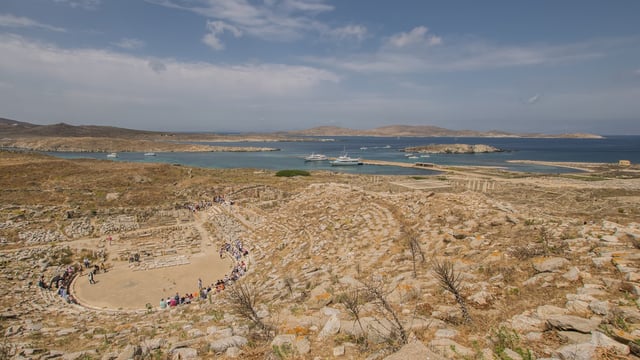
The archaeological site on the island of Delos is the remains of a sanctuary to the gods Apollo and Artemis, and the city that developed around it. The on-site museum has one of the finest collections of ancient Greek sculpture, as well as displays exhibiting numerous artefacts recovered from excavations around the island. These artefacts give an insight into the daily life of the ancient inhabitants of the island.

Did You Know? A Few Key Facts About Delos
For an island that is no more than 5 kilometres long and around 1,300 wide the estimated population for 90 BC is 30,000. The population survey carried out by the Greek government in 2001 records 14 inhabitants on the island.
Although the island was largely a religious centre, it also had a thriving commercial port. An estimated 750,000 tons of merchandise passed through the port each year during the first century BC.
Excavations of the archaeological site started in 1872 by the Greek Archaeological Service and in 1873 by the École française d’Athènes. Archaeologists are still excavating today, although much of the work focuses on securing the site for the increasing volumes of tourists. Read more about the history of archaeological research on the island on the website of the French school in Athens.
As the island has been uninhabited since the 7th century BC, the integrity of the archaeological site remains largely intact. And restoration work on the buildings has not challenged the site’s authenticity, as has been the case elsewhere. For these reasons, as well as the historical and archaeological significance of the place in antiquity, Delos was placed on the UNESCO list of World Heritage Sites in 1990.
How to get to Delos
You can only get to Delos on a day trip by ferry from another island. Most commonly the point of departure is Mykonos, but there are also day trips to Delos from the islands of Naxos and Paros. There are no hotels or other accommodation providers on the island, the only inhabitants are the caretakers and archaeologists. There is no airport on the island.
Private yacht to Delos
If you have your own yacht, you can get yourself to Delos. Sail to the island, and simply pay at the ticket office to tour the site and museum. If like me you do not have your own yacht, for what seems to me a very reasonable price you can take one of a number of private cruises to the island – and even visit nearby Rhenia Island too.
Naxos to Delos
At 8.45 am the ferry leaves the port in Naxos town and sets sail for Delos. You will have three hours to explore the island before heading to Mykonos where you have three hours to explore the old town of Mykonos. I can recommend visiting the Mykonos Archaeology Museum. This ticket only covers your ferry to Delos and Mykonos and return to Naxos. It does not include a guide, or the entry to the archaeological site and museum on Delos. Click here for more details, and to buy a refundable, return ticket from Naxos to Delos.
Paros to Delos
Getting to Delos from Mykonos
By far the most popular and easiest way to get to Delos, is from Mykonos. Whether you want to stay on the island only to visit Delos, or to stay a bit longer, Mykonos is a wonderful island to visit.
Ferries run regularly from Mykonos to Delos from 1 April to 31 October 2023. See the Mykonos-Delos ferry timetable below.
A much reduced service is offered for the month of December. These dates have not been posted.
The ferry to Delos from Mykonos leaves from Mykonos Old Port.
Buying tickets for the Mykonos - Delos ferry
You can purchase a ticket at the booth next to the ferries in the Old Harbour. Given the restrictions, however, and that Delos is the most popular attraction – it is obviously advisable to book in advance.
There is a ticket booth next to the pier where the Delos ferry births. Here you can buy return tickets for €22 (this does not include entry to the site). Or, for a booking fee of €4, you can buy a ticket online, in advance. You have the added benefit of the ticket being fully refundable should you need to cancel (up to 24 hours). Click here for more details, and to book a refundable, return ferry ticket online, in advance.
Please note: These tickets do not include a guided tour of the island and archaeological site. If you prefer to have a guided tour, these are available for €60 – they include the ferry trip, entry to the site and the guide’s fees. See the section on Guided Tours below.
The Greek Ministry of Culture administers the tickets to the Delos site, but they are not related to the ferry company from Mykonos, so it is not possible to buy a ferry ticket with an entry only ticket without a guided tour.
The Mykonos to Delos ferry schedule for 2024
| Monday Morning Ferry Times | |
| 10.00 from Mykonos, 13.30 from Delos | 1 April to 30 November |
| Monday Afternoon Ferry Times | |
| 17.00 from Mykonos, 20.00 from Delos | 2 May to 4 September |
| 16.30 from Mykonos, 19.30 from Delos | 5 - 20 September |
| 16.00 from Mykonos, 19.00 from Delos | 21 September - 3 October |
| 15.30 from Mykonos, 18.30 from Delos | 4 - 16 October |
| 15.00 from Mykonos, 18.00 from Delos | 17 - 28 October |
| Tuesday - Sunday Morning Ferry Times | |
| 9.00 from Mykonos, 12 noon from Delos | 1 April to 30 November |
| 10.00 from Mykonos, 13.30 from Delos | 1 April to 30 November |
| 11.30 from Mykonos, 15.00 from Delos | 1 April to 30 November |
| Tuesday - Sunday Afternoon Ferry Times | |
| 17.00 from Mykonos, 20.00 from Delos | 2 May – 4 September |
| 16.30 from Mykonos, 19.30 from Delos | 5 - 20 September |
| 16.00 from Mykonos, 19.00 from Delos | 21 September - 3 October |
| 15.30 from Mykonos, 18.30 from Delos | 4 - 16 October |
| 15.00 from Mykonos, 18.00 from Delos | 17 - 27 October |
Note:
- The ferry crossing takes 30 minutes.
- The time pairings for the ferry from Mykonos to Delos, and then the return from Delos to Mykonos, allow for 3 hours in the morning and 2 hours in the afternoons/evenings.
- When possible, you can take a later ferry. For example, if you travel on a Tuesday at 9.00 am, you are not required to take the 12 noon return sailing to Mykonos. You can take a later ferry should you wish to stay longer on the island. This is not possible in the evenings as there is only one return ferry journey daily.

Delos Entrance Fee
Unless you have reserved a guided tour of Delos that includes the entry fee, you are still required to pay to enter the site when you get off the ferry. As of 2021, the entrance fee for the Archaeological Site and Museum of Delos is €12 for an adult (if you qualify for a reduced ticket – that is €6, take your passport).
Guided Tours of Delos for Summer 2023
Guided tours of Delos cost €60 per person. Included in that price is a return ferry trip to the island from Mykonos, entry to the archaeological site and museum, and the guide’s fees. It is not possible to buy a ferry ticket and entry ticket without a guided tour.
Guided tours are available in English, Italian, Spanish, German and French.
For an extra cost you can include a transfer from your hotel/accommodation to the port.
The guides follow a set route around the main features of the archaeological site, before leaving you at the museum to explore that yourself with ample time to see more of the site if you wish. If you do not know much about Greek archaeology and history, I strongly recommend taking a tour. The few people I spoke to all enjoyed the guided tour, coming away feeling their guides gave them a great introduction to the history of the site. The guides will take you to the highlights and explain what otherwise looks like a pile of rocks. While standing around listening to a guide in the heat of a summer’s day is not always a great way to visit an archaeology site, as you have limited time on the island, a guide beats reading a guidebook or the text-intensive information panels.
A big plus with taking a guided tour is that you do not have to wait in a queue once you reach the island to buy an entrance ticket.

Self Guided Tour of Delos
You do not have to take a guided tour. In which case, purchase your ferry ticket at the booth on the pier (or at any of the travel agents in Mykonos) for €20 and then pay a further €12 at the site ticket office when you arrive on the island. A total cost of €32. Or, if you are on Paros or Naxos, the €50 to cover the ferry ride to Delos and the €12 entry fee to Delos.
Archaeology Travel Tip
If you choose this option, I recommend being ready to get off the ferry as soon as it docks. Ferries from Mykonos and Naxos/Paros arrive around the same time and all those people who are not booked on a guided tour are then required to queue for a ticket to enter the site. You can wait up to 30 minutes if you are last off the boat. So as the boat nears the island, stand at the back of the boat and be ready to be one of the first off the boat. And then hot foot it to the ticket office. There is no time to be taking in the atmosphere once your feet are back on terra firma and taking photographs. Do that after you have your ticket.
To stay ahead of the groups being led by guides, I headed straight to the museum. There were only two other people going round the galleries at the same time as I did.
Interactive Map of Delos

For those who would like to take a self guided tour of the island, have a look at our suggested route. Click on the satellite image to use our Interactive Map of the Island of Delos.
Guide Books and Pamphlets

A free pamphlet, Delos, is available at the ferry ticket office on Mykonos and the site ticket office. This is a basic leaflet. And while it does have a map, it is a simple one; but enough to get around the site and see some of the main features.
The best, and also free (although definitely worth a few Euros!), leaflet I found was in the archaeology museum in Mykonos: A Tour of the Archaeological Site of Delos. This not only has an excellent map, with nearly 100 features marked, it also has three suggested routes, taking an hour and a half, three hours and five hours. The pamphlet also has a good line-drawing showing a reconstruction of the sanctuary and ancient town. From this you get an excellent idea of just how extensive the ancient town was at its height.
Is Delos Worth a Visit?
Besides being one of the most important mythological, historical and archaeological sites in Greece, Delos is a wonderful island to visit. Whether you catch the ferry to Delos to take in as much of its cultural significance as you can, or go to experience for yourself one of the most evocative heritage sites in Greece, you will not be disappointed. The island of Delos truly does have something for everyone visiting Greece.
For those passionate about Greek history and archaeology, you may want to know why the archaeological site of Delos is so important? There are at least three broad reasons why the site is culturally significant.
First, architecture on Delos had a great influence on the development of architecture elsewhere during the Greco-Roman period. Second, from the 3rd millennium BC to the 7th century AD the island was an important place for the civilisations of the Aegean. For example, from the 7th to the 1st century BC, Delos was the site of one of the most important Hellensitic sanctuaries. Until at least 316 BC every four years in May the island hosted the ‘Feast of the Delians’, which was one of the major events of the region on a par with the the Olympic and the Pythic Games. Finally, Delos is directly associated with one of the main myths of Hellenic civilisation: it was on the island that Leto gave birth to Apollo and Artemis.
Added to the historical significance of the place itself, is the archaeological importance. For the casual visitor, if you are going to visit an archaeological site, you can’t do much better than Delos. And certainly, there is nothing else to see on Mykonos. Not only is the archaeological site an outstanding example of a religious sanctuary and a complete Mediterranean port and settlement, the preservation and authenticity of the site is quite exceptional.
Added to all this, the ferry ride from Mykonos to Delos is only 30 minutes, which is in itself an adventure for some. And considering three hours is the longest time you will have to stay on the island, both lovers of archaeology and Greek history and incidental tourists are catered for. Three hours is ample time to explore a lot of the site, and also a enough time to marvel at some of the highlights and enjoy a cool frappe or freshly squeezed ice cold orange juice with a spectacular view before heading back to the contemporary world.

Online or Virtual Tour of Delos
For those of you who can not get to Delos for whatever reason or those who are researching an upcoming trip to Delos – why not take a virtual tour of the archaeological site online? I recommend starting with the the two YouTube videos below. The first is a short clip (only two and a half minutes), the second is longer at just over 23 minutes. Whereas the first is a spectacular editing of drone footage, the second is short documentary created in 2015, directed by Andonis Kioukas and narrated by the Greek-French actor Georges Corraface. Both videos have their place in creating your own virtual experience, wherever you are. Also thoroughly enjoyable preparation research for anyone planning a trip to Delos.
Start with the shorter clip, if only to get a feel for this wonderful site. Then, I recommend watching the second video.
Having got a feel for the island, you can then explore the various features that interest you using our interactive/annotated Google map of Delos. First turn the map to satellite view (top left). This will give you an aerial view of the island, which you can zoom in on. Click and drag the yellow pegman (lower right) onto the map – drop it onto any of the blue dots that appear. These are 360° panorama photographs taken at the marked location. My numbered and named markers will help orientate you within the site. Unfortunately, Google has not produced a streetview walk through of the archaeological site; hence the lack of blue lines for those who notice they are missing.
Drone footage of the archaeological site of Delos

2015 documentary about Delos

Archaeology Travel Writer