
Auvergne-Rhône-Alpes
Art, History & Archaeology Sites & Museums
From the peaks of Mont Blanc in the east to the tips of volcanoes in the west, and the Rhône Valley in between, the Auvergne-Rhône-Alpes region of France provides picturesque settings for some of the most fascinating archaeological and historical sites. From Roman ruins to Romanesque churches, striking Gothic cathedrals to and magnificent castles and fortresses. The city of Lyon is widely recognised for its archaeology and history and is included on the UNESCO list of World heritage Sites. As the birthplace of Vercingetorix, Clermont-Ferrand is thought to be one of France’s oldest cities.
Auvergne-Rhône-Alpes is one of 13 regions of metropolitan France. The region was created in 2016 by the joining together of the two former regions of Auvergne and Rhône-Alpes. Now the region is made up of 12 administrative departments (Ain, Allier, Ardèche, Cantal, Drôme, Haute-Loire, Haute-Savoie, Isère, Loire, Puy-de-Dôme, and Rhône and Savoie) and one metropolis (Lyon). From tourist perspective, the region is divided in three: Auvergne, Rhône Alps and, Rhône Valley. The region shares two international borders (Switzerland to the northeast and Italy to the east) and five borders with other regions (Bourgogne-Franche-Comté to the north, Centre-Val de Loire to the northwest, Nouvelle-Aquitaine to the west, Occitanie to the south-west, and Provence-Alpes-Côte d’Azur to the south-east). Some of the most well known and largest cities include: Annecy, Clermont-Ferrand, Grenoble, Lyon and Valence.
This page about the heritage of Auvergne-Rhône-Alpes, is part of our France Travel Guide. The information on this page is curated by various members of the Archaeology Travel team, based on both personal visits and research.
Regional Guides to Sites & Museums in Auvergne-Rhône-Alpes
Auvergne
Auvergne still bears visible scars of having been shaped by volcanic activity. The chain of volcanic cones are as fascinating to us today as they were to the Romans 2,000 years ago. Covering much of the Massif Central, the region has breath taking landscapes of green mountains and wild gorges that are dotted with Roman ruins, Romanesque churches and medieval castles. The departments in Auvergne are: Allier, Cantal, Haute-Loire and Puy-de-Dôme.
Rhône Valley
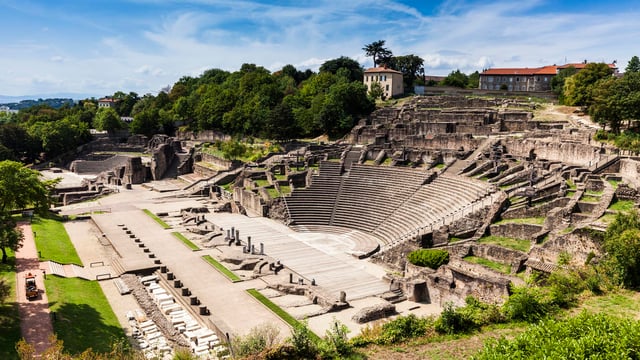
The Rhône Valley is the second largest wine producing region in France. It is the majestic Rhône River that has placed Lyon, now France’s third biggest metropolitan area, at the crossroads of Europe for millennia. Today the river transports holiday makers, in Roman times the river was a crucial waterway that led to the establishment of many Roman cites along its length. Including Lyon, Vienne and Saint-Romain-en-Gal. The departments in Rhône-Valley are: Ain, Ardèche, Drôme, Isère, Loire, Rhône.
Rhône Alpes
The high Alps to the east of this region mark the international borders with both Switzerland and Italy. The two departments that make up this area are what was the historic Duchy of Savoy; annexed by France in 1860 following the Treaty of Turin. Besides the Alps and skiing, the area is known for its quaint medieval towns; the lakeside town of Annecy an Chambéry are just two examples with well preserved historic centres. The departments in Rhône-Alpes are: Savoie and Haute-Savoie.
Thematic Guides to the Auvergne-Rhône-Alpes
Roman Archaeology
High on the summit of an extinct volcano, the Puy de Dôme, are the remains of a Roman temple dedicated to Mercury. A contrast to the archaeological remains in the important Roman cities along the Rhône River, such as Lugdunum (Lyon) and Vienna (Vienne). Here features typical of Roman cities can be seen, including the Temple of Augusta and Livia in the centre of Vienne, and the theatres in Lyon.