
Travel Guides by Experienced Archaeologists & Historians

South Aegean: Cyclades & Dodecanese Islands
Art, History & Archaeology Sites & Museums

The South Aegean region of Greece is made up of the Cyclades and Dodecanese groups of islands in what is the central and south-eastern Aegean Sea. From Rhodes in the east to Milos in the west, Andros in the north to Santorini in the south, there are 50 inhabited islands here, including some of the most popular tourist destinations in Greece. Each of the islands has their own particular character and archaeology/history. Explore the Minoan port town of Akrotiri, take a ferry to the mythological site of Delos,  or follow in the footsteps of the Crusaders and Ottomans in Rhodes. User our itinerary builder to create your own island hopping adventure. 

Reasons to Visit the South Aegean

Police marshal people streaming off a ferry that has just docked in the new port at Mykonos.

Island Hopping, 

Ruins of the Roman water cistern on the island of Karpathos, with a view on the sea behind.

Archaeology,

A reconstruction of a burial tomb, with the ceramic coffin surrounded by various decorated ceramic vessels of all shapes and sizes.

Museums,

A tray of strands of pasta drying outside as the sunsets, infront of a view of the hillside village and mountains in the background.

… Traditional Cuisine.

Interactive Map of the South Aegean Islands

Islands in the Cyclades

The Cyclades, or Kykládes nísoi – circling islands, refers to the belief by ancient people that these islands were aligned in a circle around the sacred island of Delos. Many hundreds of islands make up this the most well known and popular archipelago in the Aegean Sea. Only 33 of which are inhabited. These islands have a rich archaeological heritage, a major drive for tourism. Here we find the Bronze Age (circa 3100 – 1000 BC) Cycladic culture. Best known for its distinctive and schematic, flat sculptures of human figurines carved out of the white marble found on the islands.

The following islands are our top recommendations for archaeology and history in the Cyclades. You can find more Cycladic islands and their points of interest are included in the Interactive map of the South Aegean.

Delos Archaeological Island

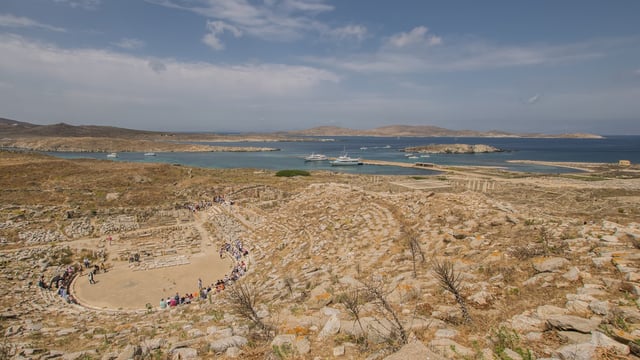
The small island of Delos, only 5 km long and 1,300 m wide, is one of the most important archaeological sites in Greece. With excavations ongoing, it is also one of the most extensively ancient Greek sites. Greek mythology has the island as the birthplace of Apollo and Artemis. A sacred sanctuary since at least the 3rd millennium BC, Delos was also an important trading port, with links reaching all parts of the Mediterranean. During the Roman era, centres of maritime trade shifted and Delos’ importance began its decline. The island was abandoned in the 8th century AD.

Paros

In ancient times Paros was well known for the fine quality of marble. The stone was quarried and sculptures exported all over the classical world, many of which are now scattered further afield in museums around the modern World. These ancient quarries can be visited, along with a range of sites from the early Mycenaean period to the more recent periods of the Middle Ages. Climb to the top of a prehistoric acropolis, or take a leisurely stroll along an ancient Byzantine pilgrimage route.

Santorini / Thira

Santorini is one of six islands that remains following the eruption of a volcano about 3,600 years ago. This so-called Minoan Eruption, thought to be the largest volcanic eruption in recorded history, wiped out the Minoan settlement of Akrotiri on the island, and the ensuing tsunami is thought by some archaeologists to have lead to the end of the Minoan Civilization throughout the Aegean. Covered by volcanic ash, the Bronze Age port-town of Akrotiri is not only very well preserved, the archaeological site is often likened to Pompeii.

Naxos

Visitors to the island arriving by ferry are greeted by the ruins of an ancient temple, thought to be dedicated to Apollo. As the largest of the Cycladic islands, Naxos has a significant history and is therefore a great destination for exploring archaeological and historical sites. In prehistory the island was at the centre of the prehistoric Cycladic Culture. More recently, in the aftermath of the Fourth Crusade, Naxos was at the political centre of the Duchy of Naxos, and some wonderful Venetian castles and forts can be visited.

Mykonos

Known as the island of the winds, hence the windmills, Mykonos is also know as a luxury and cosmopolitan destination. Beyond the main town, with its expensive shops and night clubs, lies another side of Mykonos. Picturesque villages with stone-paved alley, whitewashed houses and small churches. There are a few archaeological sites on the island, but the museum is one of the best island museums in Greece. Mykonos is the best island from which to visit the Archaeological Site of Delos.

Milos

Famous for the Venus de Milo, Milos is another of the Aegean volcanic islands, but its archaeology was not as dramatically altered as on Santorini. Rather than covering prehistoric settlements in volcanic ash, the economy of the island in prehistory developed with the exploitation of obsidian. Stone tools made using this volcanic glass were much sought after in the past, and have been found at archaeological sites on neighbouring islands, elsewhere in Greece and even further afield.

Ios

Ios is one of those unexpected gems of the Aegean sea. Known for its vibrant night life, particularly during the height of the summer season, the island in fact attracts a wide range of people from all over the World. Here visitors will find some of the best beaches in Europe in some of the most scenic of island landscapes, Byzantine churches everywhere, outstanding restaurants providing the best traditional Greek dishes, and one of the most important prehistoric archaeological site in the Cyclades. Here you will also find what some think is Homer’s tomb.

Islands in the Dodecanese

The name Dodecanese means ‘twelve islands’ and refers to the 12 main islands in the archipelago of the south-eastern Aegean Sea. In total the group is made up of 164 islands, of which 26 are inhabited. The name Dōdekanēsos was first used to refer to the 12 main islands surrounding Delos. The name came to be used to refer to islands in the south-eastern Aegean Sea when in 1913 Greeks were pressing to have these islands ceded from Italian rule to Greece. Following the 1522 Ottoman conquest of the islands held by the Knights Hospitaller, 12 islands (besides Rhodes and Kos, which were under direct Ottoman rule) enjoyed certain privileges in taxation and self-government. During the Italo-Turkish War of 1912 the Italians captured the islands. The occupying authorities even referred to them as Rodi e Dodecaneso. The islands joined Greece in 1947. This complex medieval history is reflected in the Byzantine and medieval monuments of these islands.

The following are our top recommendations for archaeology and history in the Dodecanese. See more in the above interactive map of the South Aegean.

Rhodes

Known for the  Colossus of Rhodes, which stood in the harbour during the 4th century BC, and the spectacular medieval Old Town of the Knights of St John, the island has a long and sometime turbulent history. One where ancient Greece still blends with the Crusaders and the Ottomans. As the fourth largest of the Greek islands, Rhodes is also known of its natural beauty, from sandy beaches to pinewood covered mountains. The Pelekanos River valley is known by many as Butterfly Valley – home to the Jersey Tiger butterfly as they hatch in June.

Kos

You have heard of the Hippocratic Oath, in the 4th century BC Kos was home to Hippocrates, the father of medicine. The third largest of the Dodecanese islands, Kos is popular among tourists in search of archaeology and history, as well as beaches and nature, picturesque villages and a vibrant night life. In the town of Kos, Classical and medieval ruins appear as if to be scattered among more recent Ottoman and Italian architecture. Kos is well connected to other islands and the Greek mainland by ferry and flight. The international airport allows for flights between Kos and a number of European countries, usually from April to October.

Karpathos

Karpathos is a long thin island on the south eastern edge of the Aegean Sea, between Crete and Rhodes. Besides magnificent pine-covered mountains and beautiful beaches with cobalt-blue water, the island has many fascinating archaeological and historical sites that bear testimony to the complex history. Take a boat trip to remote prehistoric settlements, or hike along ancient paths to Roman sites and Byzantine churches.